

As a Bundjalung woman, a strategist, and someone who has spent more than two decades working at the intersection of people, culture, and systems, I’ve seen firsthand the difference between what organisations say they value and what their Indigenous employees actually experience.
When the first Gari Yala (Speak the Truth) report was released in 2020, it was the first Indigenousled national study to centre the voices of Aboriginal and/or Torres Strait Islander workers. It offered a dataset grounded in lived truth: widespread racism, cultural unsafety, identity strain, and the invisible (and uncompensated) burden of cultural load. It gave Australia a blueprint for action through its Ten Truths for creating culturally safe workplaces.
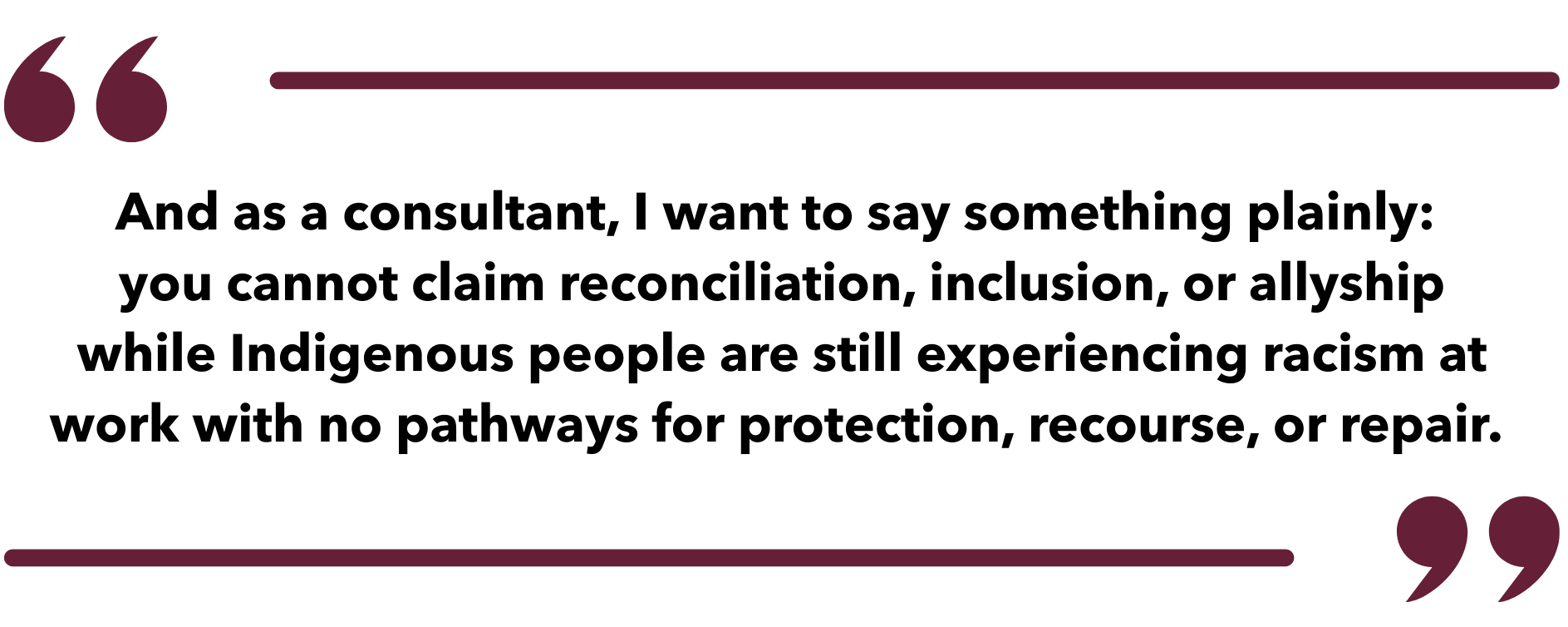
Six years later, the latest Gari Yala (Speak the Truth) 2026 report shows us that while more Indigenous people are speaking up, the environments around them haven’t shifted nearly fast enough. Of the 1,158 Indigenous employees surveyed, only 40% consider their workplace to be culturally safe, 63% report there is no antidiscrimination training that addresses racism toward Indigenous peoples, and 69% say their workplace does not have a racism complaint procedure at all.
These aren’t “gaps.”
They’re system failures.
So, what do we do with this truth?
From the work we do at Elephant in the Room Consulting, here’s what I know:
1. Cultural safety is built not assumed.
It requires intentional structures, lived accountability, and leaders who understand how systems produce identity strain and exclusion. The 2026 data reinforces that cultural safety can’t be achieved through optics or campaigns, only through systemic design and courageous leadership.
2. Cultural load must be recognised, named, and remunerated.
Indigenous staff aren’t “natural educators” or default cultural advisors. That’s labour (emotional, cognitive, and communityheld) and the 2020 report made this clear. Organisations must now operationalise it.
3. Antiracism systems must be Indigenousinformed and embedded.
Training on its own won’t fix this. Complaint procedures on their own won’t fix this. It’s the integration, and the trust that Indigenous employees have in those systems, that matters. And trust is created through truthacting, not just truthlistening.
The pace of change matters. But so does the direction.
Gari Yala told us the truth six years ago.
This year, Gari Yala tells us whether we listened.
Now, leaders must decide whether the next six years will look any different.
If your organisation is ready to move from good intentions to real, measurable cultural safety – we are here to help you build systems worthy of the people in them.
Sources: UTS Centre for Indigenous People and Work — Gari Yala (2026)
Jumbunna Institute (Brown, C., DAlmada-Remedios, R., Gilbert, J. OLeary, J. and Young, N.) Gari Yala (Speak the Truth): Centreing the Work Experiences of Aboriginal and/or Torres Strait Islander Australians, Sydney, Jumbunna Institute, 2020.
Artwork credit: Gari Yala artwork by Kirsten Gray (Yuwalaraay/Muruwari).