Every year, the calendar fills with important moments of reflection, recognition and action.
National Reconciliation Week. NAIDOC Week. Supplier Diversity Month. Indigenous Business Month.
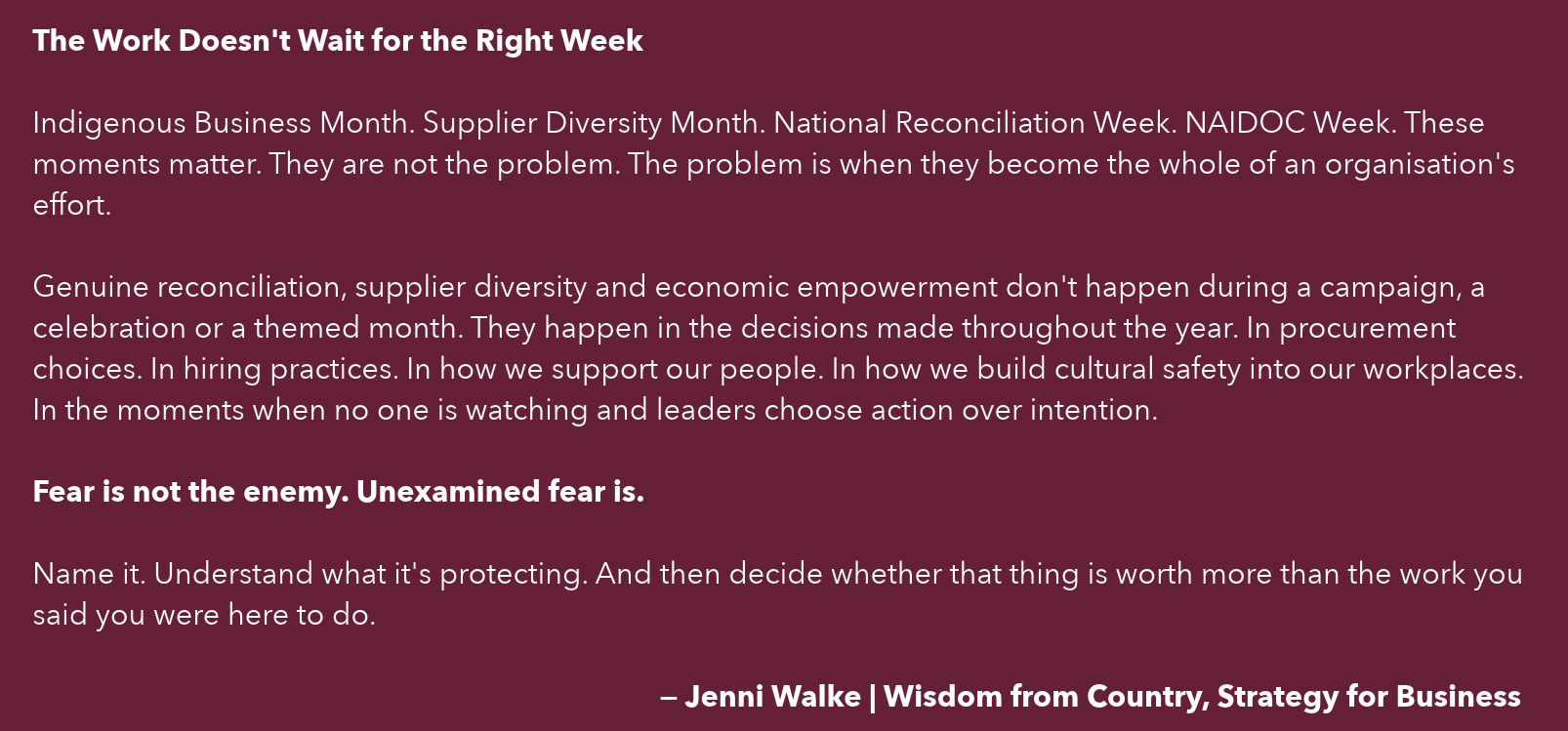
Across Australia, organisations share acknowledgements, celebrate culture, attend events, update social media channels and reaffirm their commitment to reconciliation and inclusion. These moments matter. They create visibility, spark conversations and provide opportunities to learn, connect and reflect.
But they also reveal an uncomfortable truth.
Despite the growing number of awareness campaigns and initiatives, many organisations are still grappling with the same challenge: how to turn good intentions into meaningful, lasting change.
And I want to be fair here. Most people are not acting in bad faith. They genuinely want to do the right thing. They want more diverse workforces, stronger partnerships with First Nations businesses, and deeper cultural understanding across their organisations.
The problem is that wanting to do the right thing is not the same as being willing to take action.
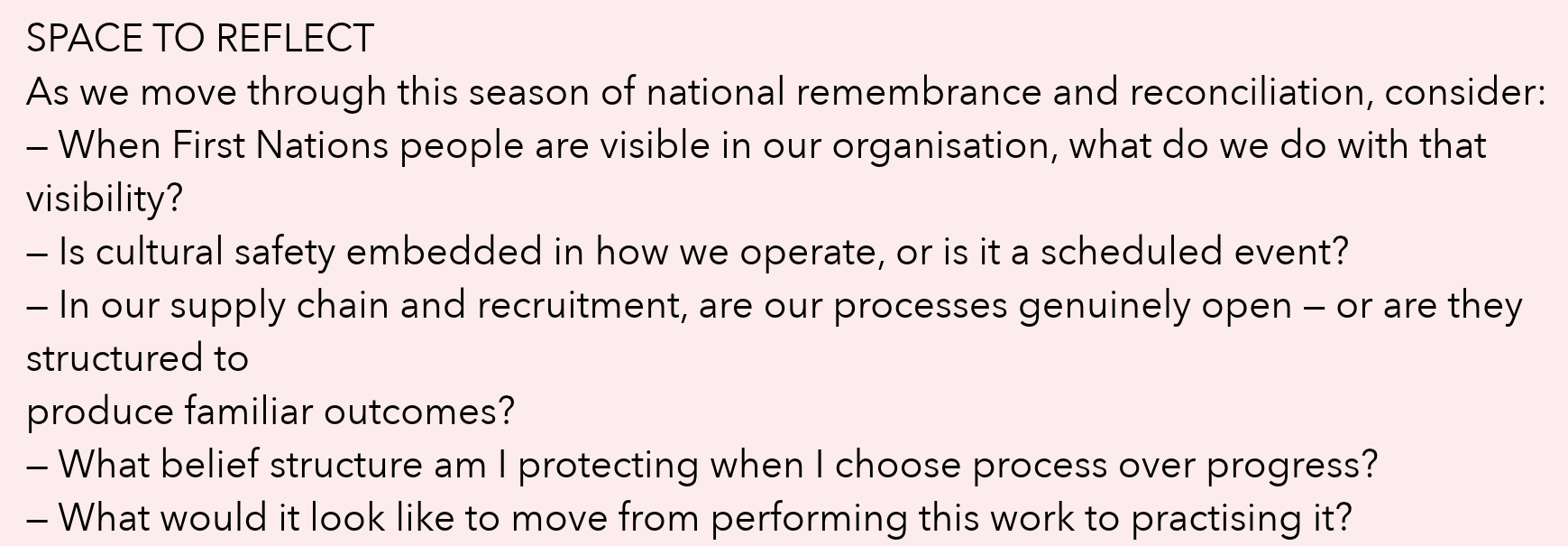
Too often, organisations become trapped by the fear of getting it wrong. Fear of saying the wrong thing. Fear of causing offence. Fear of making a mistake. Fear of stepping into territory that feels unfamiliar or uncomfortable.
So they pause. They postpone. They create another framework, another working group, another strategy document.
And while these symbolic moments continue to grow in prominence throughout the year, genuine progress remains frustratingly slow.
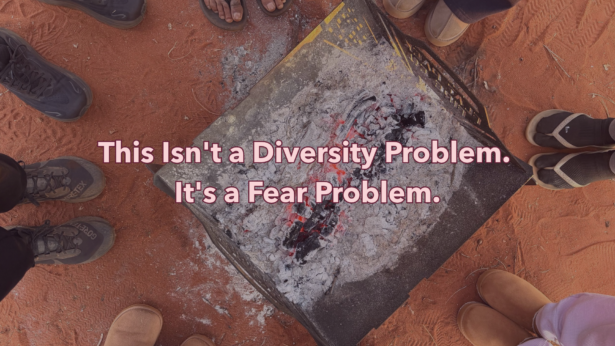
Because this isn’t really a diversity problem.
It’s a fear problem.

Fear, in an organisational context, rarely announces itself. It doesn’t walk into the boardroom and say “I’m afraid of what genuine inclusion will cost us.” It arrives dressed in something much more respectable.
It arrives as process. As budget constraints. As “we’re not quite ready yet.” As a working group that meets quarterly and produces a framework that no one is accountable for. As a cultural awareness training session bolted onto the end of an induction day, one hour, optional, no follow-up.
It shows up in supply diversity programs that celebrate the number of First Nations suppliers on a panel while the actual spend remains at 0.3%. In recruitment processes that say “we welcome applications from Aboriginal and Torres Strait Islander people” and then shortlist using criteria that structurally advantage people who look and sound like the people already in the room.
It shows up when cultural safety is treated as an add-on, a module, a policy, a box to check rather than something woven into the way an organisation actually operates, communicates, and makes decisions.
None of this is accidental. It is the architecture of managed discomfort. Just enough action to signal intent. Not enough to require anyone to fundamentally change.

Here is the uncomfortable truth about unconscious bias: it isn’t primarily about ignorance. Most senior leaders in Australian organisations today have sat through unconscious bias training. They know the language. They can identify the concepts.
But knowledge doesn’t dissolve fear. And fear is what keeps old belief structures in place.
The old belief structures that merit is objective, that the current system is basically fair, that discomfort in the room means someone has done something wrong, that cultural difference is a risk to be managed these aren’t beliefs people hold consciously or proudly. They are the operating assumptions underneath the assumptions. The ones that feel like common sense because they’ve never been seriously challenged.
And when they are challenged when a First Nations supplier pitches and the procurement team finds reasons to defer, when a cultural safety framework recommends structural change and the leadership team quietly scopes it down, when a First Nations staff member raises a concern and the HR response is to manage rather than hear what’s happening beneath the surface is a nervous system response.
The threat isn’t to the business. It’s to the identity. To the belief that the system you’ve benefited from is fair. That your success is entirely your own. That changing things would mean admitting something uncomfortable about how things got to be the way they are.

This is not a piece designed to make leaders feel bad. It’s designed to make them feel something and then choose what to do with it.
Because the leaders and organisations doing this well aren’t doing it perfectly. They’re doing it honestly. They’re asking harder questions of themselves. They’re measuring outcomes, not just activities. They’re connecting the Sorry Day morning tea to the procurement policy, to the retention data, to the cultural safety framework, to the way their leadership team responds when something genuinely difficult surfaces.
They’re treating cultural safety not as an add-on but as a condition. Not something to achieve once and tick off, but something to tend to continuously, the same way you tend to financial performance or operational risk.
And when they feel the fear because they do, everyone does they name it rather than dress it up as process. They say “this is uncomfortable” rather than “this isn’t the right time.” They sit with the discomfort long enough to understand what it’s protecting. And then they choose, deliberately, to move toward the thing that actually matters.